



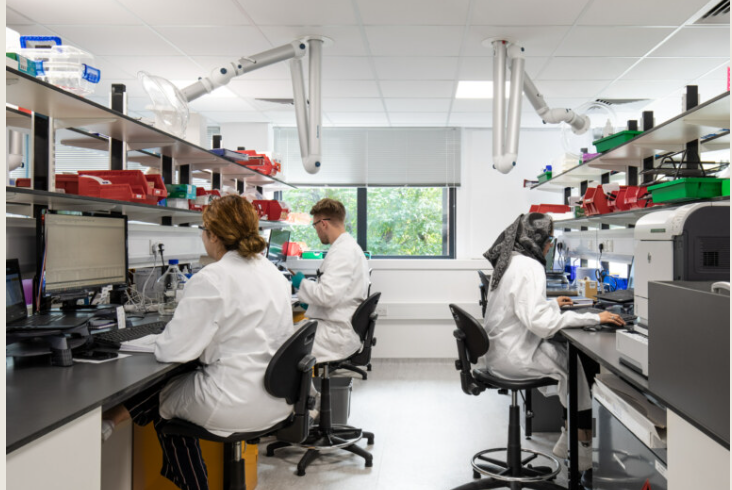
Most lab safety conversations start with rules – what to wear, what to sign off on, what to store where. That framing misses the point. The layout of a workspace, the surfaces you work on, the order in which tasks flow – these decisions shape how errors happen and how often. Getting them right is what separates a lab that produces reliable data from one that doesn’t.
Start With A Clean-To-Dirty Workflow
The most impactful change in structure that a chemical or biosafety lab can make is decoupling the physical path of a sample from its receipt to analysis. Intake is a high-contamination moment – samples arrive from outside, handling is less rigorous, and the possibility of cross-contamination is high. Your analysis zone must be protected from that.
The room should flow in one direction. Reception and prep happen at one end. High-sensitivity analysis happens at the other. Your staff should not be marching samples back through prep areas to get to the gear. This is not about cleanliness – this is about engineering contamination control into your surrounds so that it is not solely dependent on human attention.
Couple this with surface. Countertops should be non-porous, and resistant to the actual disinfectants you use. Phenolic resin and stainless are the default for everybody: they do not take spills, they do not degrade over repeated exposure to standard chemicals, and they can be completely wiped. Porous surfaces will become microbial reservoirs that no protocol will ever totally eliminate.
Sterility During Reagent Preparation Isn’t Optional
When you add water back into lyophilized powders, the concentration isn’t the only thing that needs to be exact. Lyophilization (freeze-drying) removes water while leaving the compound intact. Reintroduce impure, mineral-rich, or microbe-laden H2O and you’ll immediately start altering your sample in unpredictable ways.
Then, you’ll never be able to replicate those mistakes, because you can’t use the same vial twice. Lyophilization is expensive in time and resources, and most peptides are only available in limited quantities to begin with. Two bad draws because your water wasn’t clean enough means you’re buying another vial.
Similarly, ultra-pure grade solvents are the answer when reconstituting lyophilized peptides or preparing solutions. Reagent-grade water standards or pharmaceutical-grade diluents minimize the introduction of minerals and biologicals, each of which can degrade your peptide over time. For solutions that will be accessed more than once, bacteriostatic agents maintain sterility across multiple draws. Bac water – water preserved with benzyl alcohol – prevents bacterial proliferation in multi-use vials without interfering with the compounds being dissolved.
Equipment And Ergonomics Affect Accuracy, Not Just Comfort
According to the CDC’s Biosafety in Microbiological and Biomedical Laboratories guidelines, human error and poor technique cause roughly 80% of laboratory-acquired infections. A lot of that can be attributed to fatigue – physical and visual. A technician who has been pipetting for six hours in poor lighting conditions while hunched over a fixed-height bench is not going to be producing the same quality of work as they were in their first hour.
Different technicians can use adjustable-height workstations to work at a posture that will not cause strain over the course of their shift. Task-specific lighting at a minimum of 500 lux is important for precision work when you are dealing with small volumes such as in titration, slide preparation, or any process where you need to see small volumes distinctly. These are not ergonomics to be comfortable. They are accuracy controls.
Position autoclave access and sharps disposal in a way which minimizes how far staff have to carry contaminated materials. Every extra step between a used needle and its disposal point is a risk. The same logic applies to PPE stations. Gloves, eye protection, and lab coats need to be at the point of use, not on the other side of the room.
Chemical Storage And Waste Disposal Close The Loop
Central chemical inventory system does two things, it tells you what you have and where it is, and it forces an organizational structure that separates incompatible materials. Flammable solvents belong in dedicated cabinets, away from corrosives. This isn’t just about fire codes – accidental reactions between improperly stored reagents are a real failure mode in busy labs.
Biohazard waste needs designated, clearly labeled containers at each workstation. Staff shouldn’t be making decisions in the moment about what container a contaminated item goes into. If the right container is right there, that decision is already made.
SOPs should document the workflow, not just the rules. An SOP that describes the physical path of a sample through the lab – where it goes, in what order, handled by whom – is more useful than a list of prohibitions.
The Design Is The Protocol
A well-structured workspace cannot be a substitute for training or SOPs, however, it can facilitate their consistent implementation. When the physical organization of the laboratory helps to automatically create separation, facilitates decontamination, and protects reagents, fewer shortcuts are taken, mistakes are reduced, and the data can be considered more reliable.
This is in part because safe and efficient design helps the procedural layer of lab safety do its job, and vice versa.